Green Wave Management
INDEPENDENT BUSINESS ADVISORY
KPI Dashboard · Approach · Advisory · Insights · About · Let’s talk
A DECISION IN FOCUS / HBS teaching case
CPP Investments – The Road to Zero
Silent animation · 2:14. Use fullscreen for small text.
View static infographic
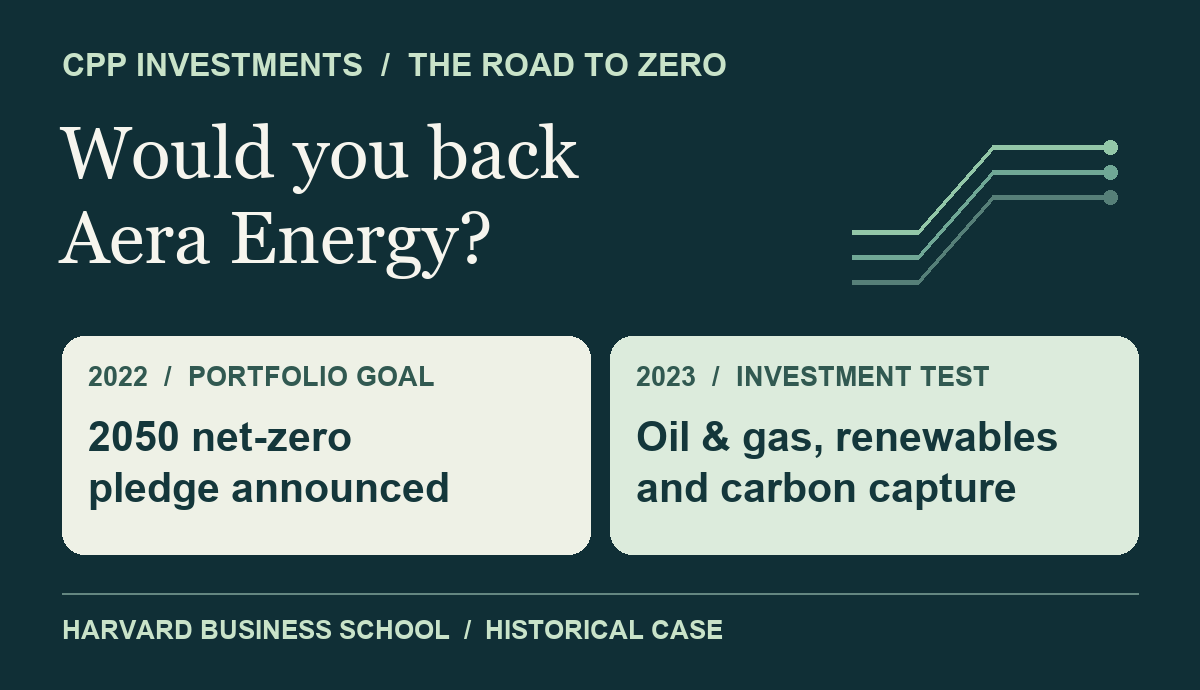
Could backing an oil and gas producer fit a pension fund’s net-zero strategy?
Historical case · Independent Green Wave analysis
Where strategy, sustainability and execution create value.
Independent advisory for investors, owners and leadership teams, connecting financial judgment, operating experience and sustainability to practical business decisions.
01 / Green Wave KPI Dashboard
The portfolio view.
The company behind every number.
Connect sustainability data to the decisions that create value. Bring common EDCI-referenced indicators and industry-specific SASB measures into one view of your portfolio and its individual holding companies.
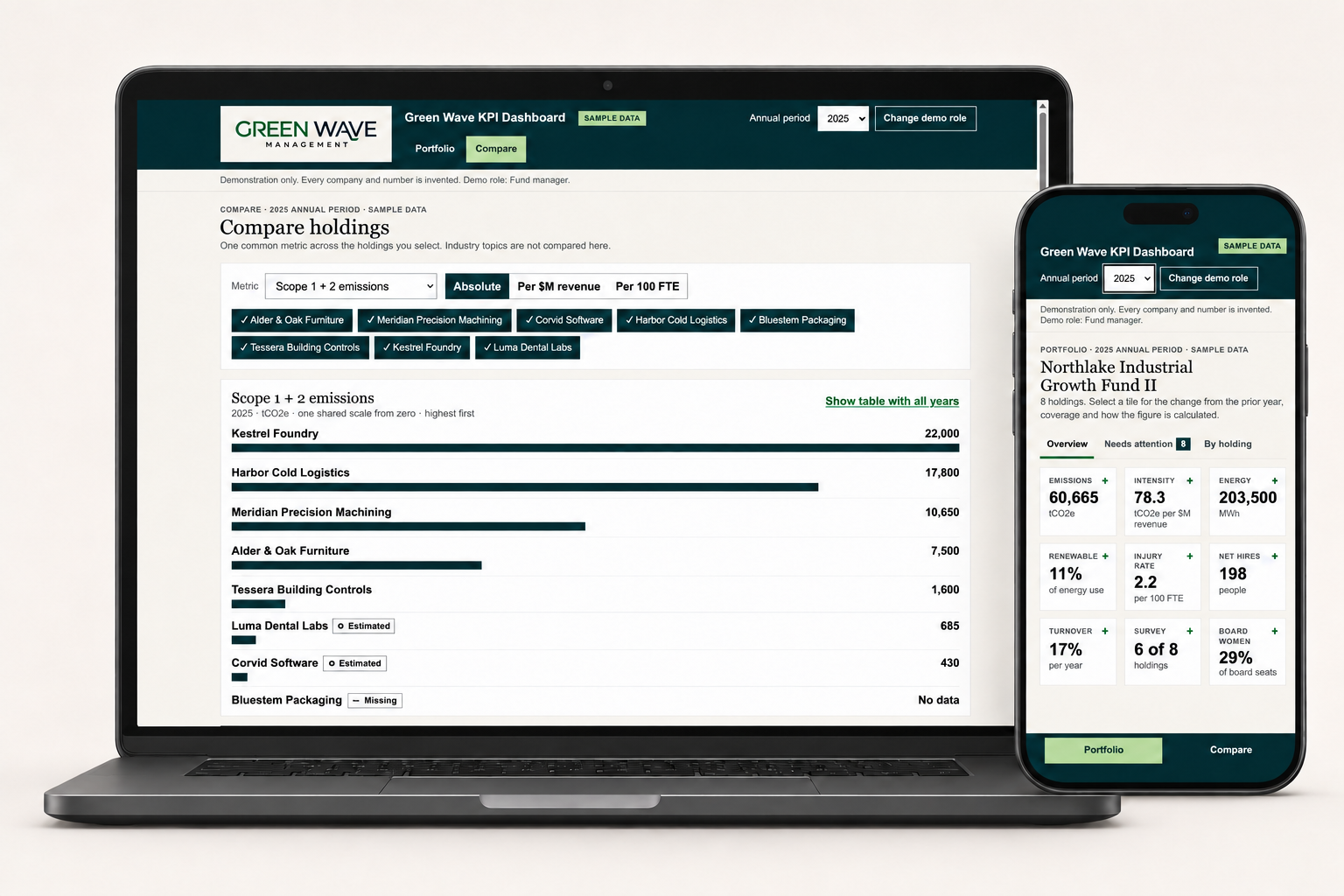
Compare holdings
Switch measures and compare absolute values, revenue intensity or values per employee where applicable.
See the portfolio
Emissions, energy, workforce, safety and board representation in a single overview.
Know the data
Reported, estimated and missing values stay visible, so gaps become questions for management.
Across the portfolio
A common basis for comparison.
Track selected EDCI-referenced indicators across holdings and annual periods. Review portfolio totals or weighted measures, check reporting coverage, and trace a change back to the companies behind it.
Emissions & energy · People & safety · Governance
Inside each holding
The industry context that matters.
Combine common metrics, multi-year trends and advisor notes with SASB-referenced industry topics—from manufacturing energy and materials to software data security. SASB Standards are maintained by the ISSB and support its industry-based approach.
Company trends · Industry topics · Management follow-up
One connected workflow, with common indicators compared across the portfolio and industry-specific measures kept in their company context.
Discuss your portfolio’s data priorities02 / How we create value
A connected view. A practical path forward.
Investment decisions and operating challenges rarely sit within one function. Start with the business question, connect the drivers, then establish a clear path to execution.
01
Frame the decision
Clarify the investment or operating context, the alternatives and the evidence needed to make a sound judgment.
02
Connect the drivers
Consider financial, operational, sustainability and data issues together. Make assumptions and tradeoffs visible.
03
Establish the path
Define priorities, responsibilities and measures of progress, proportionate to the organization’s resources and ambitions.
03 / Advisory services
Four capabilities. One business context.
For investors, owners and leadership teams assessing an opportunity, shaping a business or improving performance.
01 / Strategy & Transactions
Clarify strategic choices and assess the opportunities and risks behind investment decisions. Advisory scope includes corporate strategy, market and investment evaluation, due diligence and value-creation roadmaps.
Connect the investment rationale to business priorities.
02 / Operational Performance
Assess operating models, KPIs and management systems, with attention to accountability, performance visibility and the practical requirements of execution.
Turn priorities into a focused operating agenda.
03 / Sustainability & ESG
Connect sustainability priorities to strategy and operations. Scope includes greenhouse gas accounting, materiality, product sustainability and reporting needs, with clear boundaries and evidence.
Bring environmental intelligence into business decisions.
04 / Technology & Data Intelligence
Evaluate sustainability software and reporting workflows against business needs, data requirements and practical constraints. Focus on benchmarking, vendor assessment and data convergence planning.
Choose information and tools for the decision they support.
Insights
Founder case study · Industrial site selection
What is a power contract worth when choosing a smelter site?
A metals producer was evaluating locations for a new smelter. Economic development agencies could help make a site more attractive through incentives. Local utilities could shape the economics of running the plant for years. The board needed a recommendation that put both on the same footing.
Read the case study
The decision
Consider the scale. At an illustrative continuous load of 50 megawatts, a difference of just $1 per megawatt-hour adds up to $438,000 over a full year. An incentive has a different time profile. Its value depends on when the company receives it and what the company must do to qualify. Comparing the face value of two incentive packages would tell the board little about the cost of operating at either site.
The quoted rate showed what power would cost at the outset. The utility’s generation mix helped assess how that rate might change over the life of the smelter. Alongside fuel costs and the cost of replacing aging plants, coal-fired generation carried a transition risk. If future policy put a price on carbon emissions, each megawatt-hour of coal-fired power could carry a cost the opening rate did not reflect. A utility with a larger share of renewable generation would generally have less direct exposure to that cost.
If a coal-heavy site offered a lower opening rate, how long might that advantage last? The answer would depend on the cost of carbon, how much the utility could pass through during the contract, and the rate it offered at renewal.
How carbon pricing changes the annual power bill
The higher-emitting site starts with a $4/MWh discount. Its electricity supply emits an extra 0.4 tonnes of CO₂ per MWh. Assume both utilities pass through 50% of carbon costs and the plant draws 50 MW year-round.
| Carbon price per tonne of CO₂ | Power rate difference | Annual difference |
|---|---|---|
| $0 | $4/MWh lower | $1.75M savings |
| $20 | Break-even | $0 |
| $50 | $6/MWh higher | $2.63M extra |
| $100 | $16/MWh higher | $7.01M extra |
| $150 | $26/MWh higher | $11.39M extra |
At $100/t, directors would need to weigh roughly $7 million in extra power costs for each year at that price against the value and timing of site incentives.
From negotiations to a recommendation
In a prior corporate development role, Green Wave’s founder led the site-selection effort with a specialist adviser. He worked directly with utilities on power contract terms and with economic development agencies on the incentives available at competing locations. Those discussions informed the site recommendation he presented to the CEO and board.
The practical question for directors was how much of a site’s appeal would endure once its incentives had run their course. A power-price difference accrues with every hour of production. Looking at both over the same operating period gives directors a way to judge how large an incentive would have to be to justify accepting higher recurring costs.
The location, company and project identifiers have been omitted. The power calculation illustrates the economics using a hypothetical load and 8,760 operating hours.
04 / Founder & perspective
Financial judgment. Operating experience. A broader perspective.
Joshua Belczyk | Founder
Green Wave Management is informed by Joshua Belczyk’s experience in corporate finance, acquisitions, and executive leadership of industrial businesses, complemented by his work in sustainability and business transformation.
Having worked across investment decisions, operational improvement, and organizational leadership, Joshua brings an operator’s perspective to strategic challenges, connecting financial objectives with the people, processes, and capabilities required to execute them.
What partners and colleagues say
“Green Wave Management’s mission, vision, process, and outlook are in line with exactly what we strive toward at Engage. Josh and his team will be an immense asset to our efforts.”
CEO, Engage Energy & Industrial Consulting · On announcing the Green Wave partnership
“Josh is an outstanding young professional who initially identified Zochem as a potential acquisition, and he was instrumental in evaluating, recommending and selling the Board on the merits of this transaction.”
Former Director, Horsehead Holding Corp.
“Perhaps his most notable achievement is that through this transformation he created a culture which has resulted in five consecutive years without a lost time injury.”
President & CEO of Horsehead Holding Corp.
“The results speak for themselves: excellent strategic thinking, great execution of aggressive business plans, recognition for excellent quality products, and most importantly, overseeing the achievement of a virtually flawless safety record.”
Retired Lead Director, Horsehead Holding Corp.
05 / Let’s talk
What decision is next for your business?
An investment, an operating challenge or a growth opportunity. Begin with the question that matters.
Start with a conversation.
Share a brief outline of your priorities, your organization and the timing you have in mind.
Inquiries are reviewed personally by Joshua Belczyk.